Nuts are nutritional powerhouses, but after age 40, when the body’s needs shift toward managing inflammation, protecting heart health, and maintaining hormone balance, the way you choose and prepare them becomes more critical.
Focusing on raw or dry-roasted varieties and avoiding common pitfalls will maximize their “anti-aging” benefits.
The “Worst” Nuts to Avoid (Or Consume Rarely)
The primary problem with nuts is usually not the nut itself, but how it is processed. For the sake of heart health, inflammation control, and hormone balance after 40, here is what to avoid:
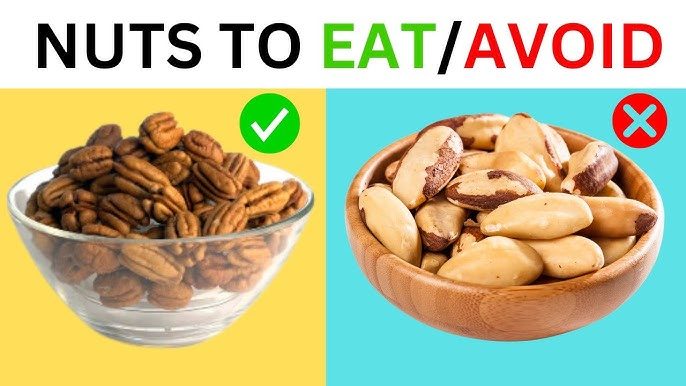
| Nut Type | Primary Concern | Why to Limit |
| 1. Oil-Roasted, Salted, or Honey-Coated Nuts | Excess Sodium, Sugar, and Inflammatory Fats | Commercial roasting often uses cheap vegetable oils high in $\text{Omega-6}$ fats, increasing inflammation. Added salt elevates blood pressure, and sugar accelerates aging and contributes to metabolic issues. |
| 2. Peanuts (Technically a Legume) | High $\text{Omega-6}$ to $\text{Omega-3}$ Ratio & Aflatoxin Risk | While nutritious, peanuts have a high $\text{Omega-6}$ content, which can be pro-inflammatory when consumed in excess. They are also prone to mold (aflatoxin), which is harmful to the liver. Choose pure, unsalted peanut butter. |
| 3. High Saturated Fat Nuts (e.g., Macadamia Nuts, Cashews) | Saturated Fat Content | Both macadamias and cashews have high amounts of saturated fat compared to other nuts. While acceptable in small amounts, prioritizing nuts with higher unsaturated fats is generally better for heart health. |
| 4. Nuts Past Expiry | Rancidity and Toxin Risk | The healthy fats in nuts can go rancid quickly. Rancid fats increase cellular damage (oxidative stress), which accelerates aging. Always store nuts in an airtight container, preferably in the refrigerator or freezer. |
The Best Nuts for Health and Vitality After 40
These nuts are loaded with vitamins, minerals, and fatty acids that directly support heart, brain, and hormone health during middle age. Aim for a small handful (about 1.5 ounces or 40 grams) per day of raw or dry-roasted, unsalted varieties.
| Rank | Best Nut | Primary Benefit & Key Nutrient | Why It’s Best After 40 |
| 1 | Walnuts | $\text{Omega-3}$ Fatty Acids ($\text{ALA}$) | They have the highest $\text{ALA}$ (plant-based $\text{Omega-3}$) content of any nut, which is crucial for reducing inflammation, supporting brain health, and lowering the risk of heart disease and stroke. |
| 2 | Almonds | $\text{Vitamin E}$ and $\text{Calcium}$ | Rich in antioxidants (Vitamin E) that protect cells from damage and support the immune system. They have the highest calcium content among nuts, which is vital for maintaining bone density after 40. |
| 3 | Brazil Nuts | Selenium | Just 1 to 2 nuts per day provides the entire daily recommended intake of $\text{Selenium}$, a powerful mineral necessary for antioxidant protection and proper thyroid function, which often slows down with age. |
| 4 | Pistachios | $\text{Lutein}$ and $\text{Zeaxanthin}$ | Unique among nuts for their high levels of $\text{lutein}$ and $\text{zeaxanthin}$, two antioxidants that are essential for eye health and protecting against age-related macular degeneration. |
| 5 | Hazelnuts | Mono-unsaturated Fats and $\text{Vitamin E}$ | Very high in $\text{oleic acid}$ (like olive oil) and $\text{Vitamin E}$, which helps improve blood lipid profiles, manage $\text{LDL}$ cholesterol, and protect the skin and cellular structure. |